


Ancient Greek coins for sale
Ancient Greek coins for sale offer collectors and investors the opportunity to acquire authentic artifacts from one of the most influential civilizations in history. Struck between the 7th century BCE and the Roman conquest, these coins combine historical importance, artistic excellence, and enduring numismatic value. Our selection of genuine ancient Greek coins includes silver drachmas, tetradrachms, and bronze issues from renowned city-states, carefully authenticated and preserved. Ancient Greek coinage represents the foundations of monetary systems, trade, and political identity in the ancient world. Each piece reflects the power, beliefs, and craftsmanship of its issuing city-state. Owning an ancient Greek coin means holding a tangible fragment of history that has survived for more than two millennia.
History and periods of Greek Coinage
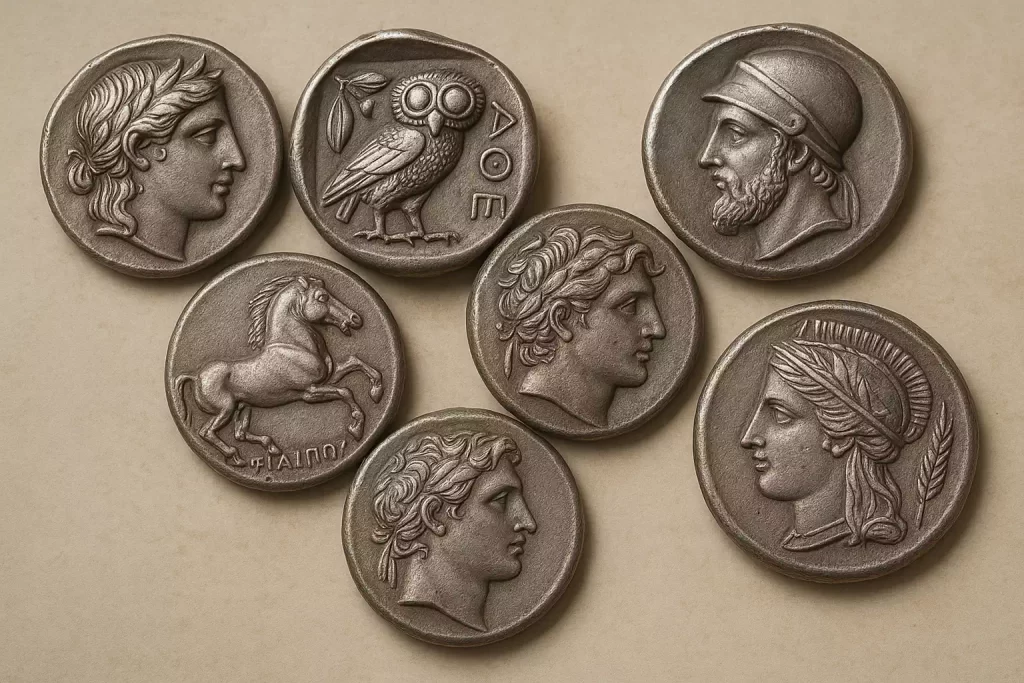
Greek coin production developed through several key periods, each marking a major evolution in design, circulation, and political influence. The Archaic period (7th–5th centuries BCE) introduced the first standardized coins, often bearing simple symbols associated with local deities and civic identity. These early issues laid the groundwork for all later coinage. The Classical period (5th–4th centuries BCE) produced some of the most iconic ancient Greek coins, including the famous Athenian owl drachme. These coins circulated widely across the Mediterranean, reinforcing Athens’ economic and political dominance. Their balanced designs and refined engraving techniques remain benchmarks in numismatic art. During the Hellenistic period (4th–1st centuries BCE), coinage expanded dramatically alongside Greek influence. Portraits of rulers, larger denominations, and increased silver production reflected the growing scale of trade and empire. Greek coinage continued under Roman authority, blending Greek artistic traditions with Roman administration, resulting in historically rich and highly collectible issues.
Types and denominations of ancient Greek coins
Understanding denominations is essential when buying ancient Greek coins. The drachma was the most widely used silver coin, forming the backbone of Greek monetary systems. The tetradrachm, valued at four drachmas, was commonly used for large transactions and international trade and is among the most sought-after coins by collectors today. Smaller denominations such as obols, diobols, and triobols supported everyday commerce and provide insight into daily economic life in ancient Greece. Bronze coins, while less valuable than silver issues, circulated extensively among the general population and remain important for understanding regional economies and local minting practices. Each denomination played a precise role within a structured monetary system, making ancient Greek coins both historically informative and highly collectible.
Artistic excellence and regional variations
Ancient Greek coins are renowned for their exceptional artistry and distinctive regional styles. Each city-state expressed its identity through unique symbols and imagery. Athens featured Athena and her owl, symbols of wisdom and civic protection. Corinth displayed Pegasus, reflecting mythological heritage and divine favor. Syracuse produced masterfully engraved coins depicting the nymph Arethusa, celebrated for their artistic sophistication. These regional variations make Greek coins particularly attractive to collectors seeking diversity within a coherent historical framework. Every coin represents a specific place, time, and cultural identity, preserved in metal with remarkable precision.
Authenticity and provenance
All ancient Greek coins offered in this category are authentic historical artifacts. Each piece is carefully examined for metal composition, style, weight standards, and historical attribution. Authenticity and provenance are critical in numismatics, ensuring both scholarly integrity and long-term value.
Buying ancient Greek coins as an investment
Ancient Greek coins are widely regarded as stable and desirable assets within the numismatic market. Their limited supply, enduring demand, and historical importance contribute to long-term value retention. High-quality silver tetradrachms, well-preserved drachmas, and rare regional issues are particularly attractive to investors and experienced collectors. Unlike modern collectibles, ancient coins are finite historical objects. Their value is driven by rarity, condition, artistic quality, and provenance, making them a serious option for diversification within tangible assets.
Why buy ancient Greek coins?
Ancient Greek coins combine history, art, and value in a single object. They document the rise of city-states, the spread of Greek culture, and the development of early economies. For collectors, they offer depth, variety, and prestige. For investors, they represent scarcity-backed assets with strong international demand. Whether you are expanding a numismatic collection or acquiring historically significant coins as long-term holdings, ancient Greek coins remain among the most respected and sought-after categories in ancient numismatics.