
Why are coins round? Practical reasons, and global exceptions

Mar
Pick up a handful of coins from almost any country and you will see the same pattern: most are round. That seemingly trivial choice is the result of centuries of technological experimentation, anti‑fraud measures and practical engineering. From hand‑struck silver discs to today’s precision‑made tokens for vending machines and transit gates, the dominance of the circle says a lot about how money must function in the real world.
From hammered blanks to machine‑struck discs
For much of history, coins were produced by hammering. A worker placed a metal blank on a fixed lower die, set an upper die on top, then struck it repeatedly with a hammer. This process imprinted designs on both faces at once but produced coins with irregular outlines, varying thickness and ragged edges. The pieces were roughly round, yet far from perfectly circular.
Around the mid‑sixteenth century, European innovators introduced screw presses and rolling mills that transformed coin production. In Augsburg, the goldsmith Marx Schwab is credited with building machinery that could roll metal to a uniform thickness and strike blanks under heavy, controlled pressure. Hearing of this advance, King Henry II of France secretly purchased equipment and expertise, and tasked the engineer Aubin Olivier with setting up a mechanised mint at the Moulin des Étuvés in Paris.
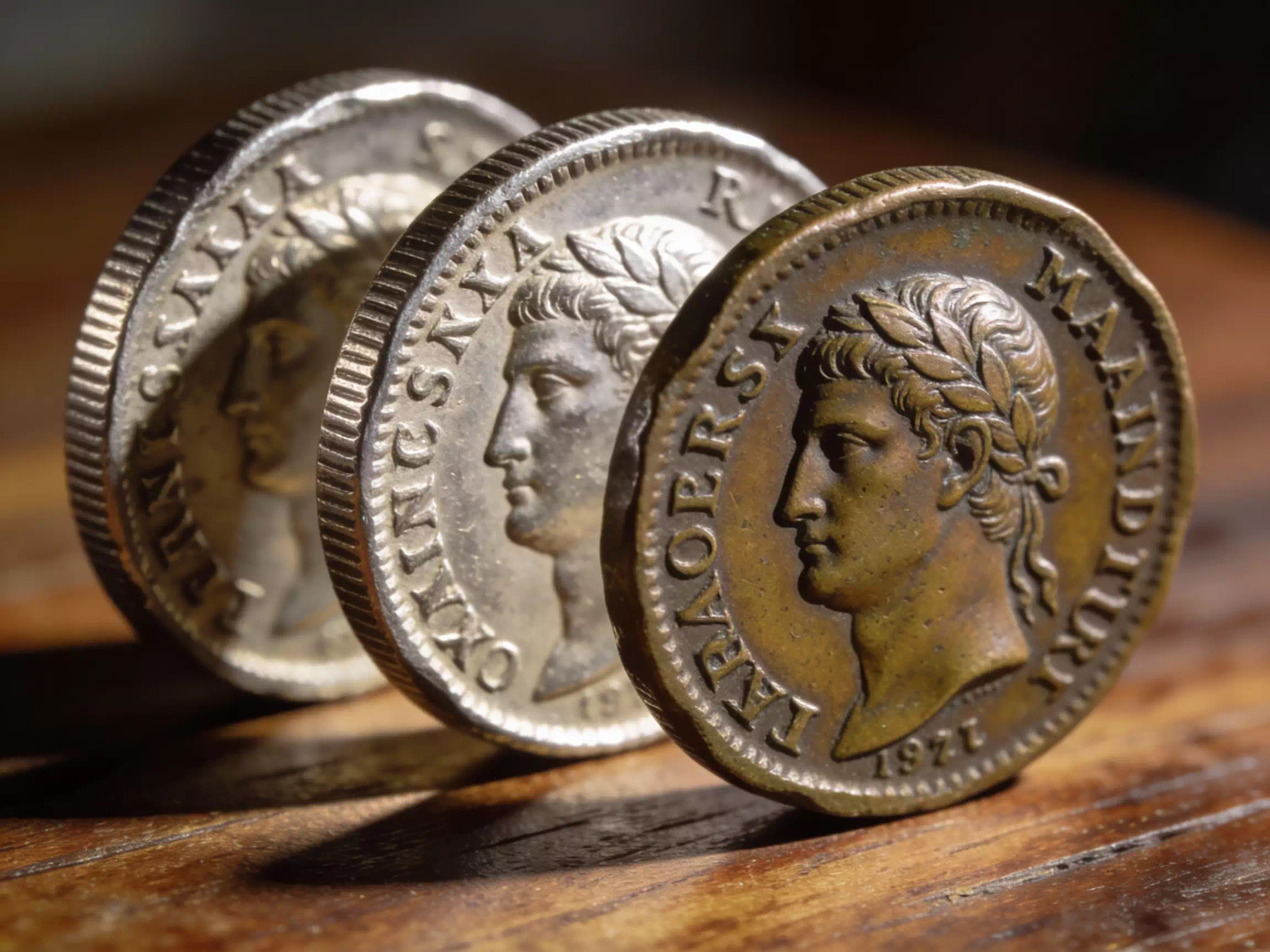
Machine‑struck, or “milled”, coins emerging from these presses were far more uniform in diameter and thickness than hammered pieces, and their edges could be shaped or marked deliberately. That regularity made them harder to counterfeit or clip, because any loss of metal from the edge became immediately obvious. The new technology met fierce resistance from traditional moneyers, so it was adopted gradually, first for high‑value coins and medals before spreading more widely.
By the late seventeenth century, mechanised coining had become standard across much of Western Europe. In England, the crisis of worn and clipped silver led to the Great Recoinage of 1696–1698. Isaac Newton, appointed Warden of the Royal Mint in 1696, did not invent milled edges but played a crucial role in organising the recall of old hammered coins and their replacement by perfectly round, machine‑struck pieces with decorated rims. These milled edges made further clipping almost impossible to hide and have remained a familiar anti‑fraud feature ever since.
Why round makes sense in manufacturing
Once mints adopted presses, the circle emerged as the most practical everyday shape. Circular dies are easier to align because their orientation does not matter: a round coin can be struck correctly at any rotational angle, unlike a square or hexagon whose corners and sides must register precisely. That simplicity reduces setup time and mechanical complexity.
In a typical modern mint, metal strip is rolled to the desired thickness, then a blanking press punches out round discs. The scrap webbing between the blanks is collected and remelted, so very little metal is wasted regardless of exact layout. What matters most is that the blanks match the dimensions and composition expected by downstream equipment, from coining presses to high‑speed counting and wrapping machines.
Round coins also spread mechanical stresses evenly during striking. Pressure in a press radiates from the centre towards a continuous rim, which helps extend die life. With highly angular shapes, force can concentrate at corners and wear tooling faster. For mints producing billions of pieces, small gains in die longevity translate into significant cost savings over time.

Everyday handling and machine compatibility
The everyday benefits of round coins are obvious once you think about how we use them. Circular pieces roll, stack and pour smoothly. They slide into pockets without snagging on seams and can be scooped or counted in bulk with relatively simple mechanical devices.
These properties became crucial with the rise of vending machines and other coin‑operated equipment in the 19th and 20th centuries. Coin validators typically measure several parameters as a piece travels past their sensors: diameter, thickness, mass and electromagnetic response. A round coin with a fixed diameter behaves predictably as it rolls or slides along guide rails, making it easier for the machine to route it correctly and to distinguish one denomination from another.
This is where shapes of constant width come in. A curve of constant width has the same distance between any pair of parallel supporting lines, regardless of orientation. Besides the circle, certain rounded polygons, Reuleaux polygons, share this property. When such a coin passes through a slot or against a gauge, the mechanism “sees” a constant width, just as it would with a circular piece, even though the outline feels multi‑sided to the hand.
When coins are deliberately not round
The best‑known examples of non‑round modern coins are the British 50‑pence and 20‑pence pieces. Introduced in 1969, the 50p was the world’s first seven‑sided circulation coin, its outline is an equilateral‑curve heptagon of constant width, specifically chosen so that machines could handle it like a round coin while people could easily distinguish it by touch and sight.
Security features built into shape and edge
Shape and edge design work together to protect coins from fraud. Regular circular or constant‑width outlines with tightly controlled diameters and masses make it easier for machines and humans to spot fakes that are too large, too small or too light.
Milled or lettered edges add another layer. Originally, serrations and inscriptions were meant to expose clipping on precious‑metal coins: any removal of metal from the rim would instantly mar the pattern. During the Great Recoinage, the switch from ragged hammered edges to clean milled rims helped restore trust in English silver, and similar techniques spread internationally. Today, even base‑metal coins keep edge treatments both as a nod to that history and as a tactile cue to differentiate denominations.
Coins in an increasingly digital world
If you look closely at a coin, its roundness is anything but accidental. It is the outcome of centuries of trial and error in minting, fraud prevention and everyday handling, from the first machine‑struck pieces in early modern Europe to the precisely engineered tokens that pass through today’s coin‑operated mechanisms. The circle, or more broadly a shape of constant width, turns out to be a compact answer to many competing constraints at once.
A round planchet is economical to strike, distributes pressure evenly in the press, offers a clean rim for anti‑clipping features and behaves predictably in counting machines and validators. Non‑circular coins such as the British 50p or other Reuleaux‑based designs only succeed because they preserve that same constant‑width behaviour while adding tactile and visual distinctiveness.
That balance between geometry and function explains why, despite changes in metals, technologies and payment habits, the basic outline of the coin has changed so little. As long as we use metal tokens at all, the simple, robust logic behind the round coin will continue to shape what money looks and feels like in the hand.
Further reading
- https://www.perthmint.com/news/collector/coin-collecting/how-isaac-newton-helped-shape-our-coins/
- http://www.lesnumismates.ca/?p=166
- https://britanniacoincompany.com/blog/coin-clipping-the-great-recoinage-of-1696/

ClassicWorldCoins was created by a passionate collector with a deep interest in ancient coins and their stories. Through this blog, he shares his discoveries, insights, and favorite pieces to help others explore the fascinating world of numismatics.