
Roman usurpers: history, fame, and political impact in the late Empire

Mar
Between 235 and 284 CE, the Roman Empire witnessed an acute crisis of legitimacy. During roughly fifty years, emperors and rival claimants rose and fell, many ruling only briefly before being overthrown or killed. This era of chaos, known as the Crisis of the Third Century, fundamentally transformed how imperial authority functioned. Studying Roman usurpers reveals not just individual ambitions, but also structural vulnerabilities that brought the empire close to disintegration.
The term “usurper” usually describes an individual who claimed imperial power without broadly recognized or orderly succession, often through military force or regional rebellion. In some notable cases, Roman usurpation involved whole regions acting semi‑independently and creating parallel imperial structures, including their own mints, administrations, and armies, as with the Gallic and Palmyrene empires. The following overview focuses on several major usurpers, their methods of seizing power, and their wider political consequences.
Major Roman usurpers
The most consequential usurpers are usually defined as those who established de facto independent regimes, controlled multiple provinces, and forced rival emperors into prolonged civil wars. Frequently discussed figures in this category include Postumus (260–269), Maxentius (306–312), Magnentius (350–353), Magnus Maximus (383–388), and Constantine III (407–411). Their careers illustrate the mechanics of political fragmentation during periods of imperial strain.
Postumus (260–269 CE): The Gallic Empire
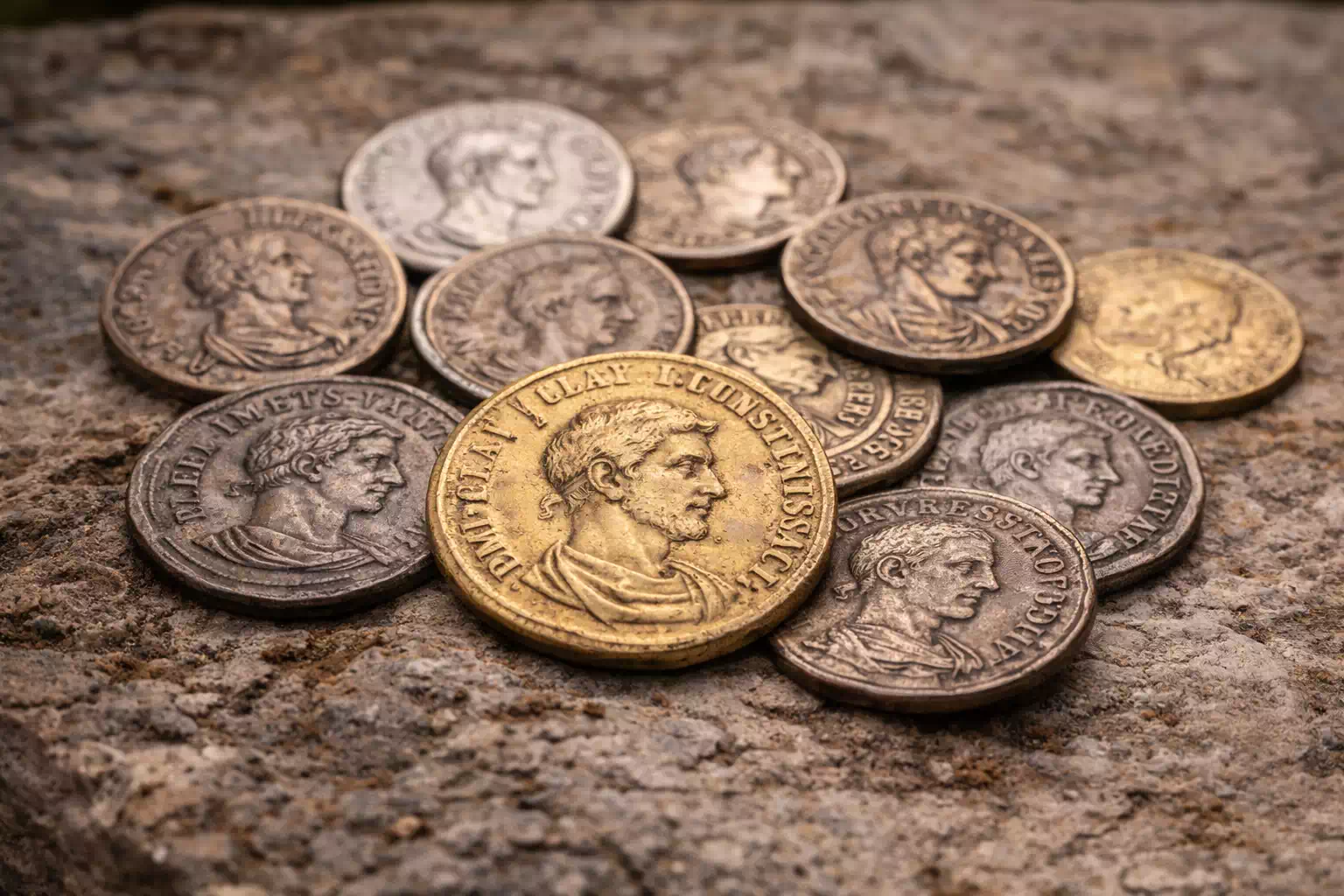
Marcus Cassianius Latinius Postumus created what many historians regard as one of the most successful breakaway states in Roman history. Proclaimed emperor by troops in Gaul around 260 CE, he secured authority over Gaul and the German provinces, and his rule was soon recognized in Britain and at least parts of Hispania. His “Gallic Empire” functioned as a de facto autonomous political entity with consuls, a senate, and its own coinage, modelled on Rome.
Postumus concentrated on defending the Rhine frontier rather than marching on Rome, gaining support among local elites and soldiers even as central authorities branded him a usurper. After his death at Mogontiacum (Mainz) in 269 in a mutiny, his regime survived under successors until Aurelian reconquered the western provinces in 274. Postumus is generally counted among the longer‑reigning usurpers, showing how strong regional backing could sustain independence when central power faltered.
Maxentius (306–312 CE): Rome’s challenger
Maxentius, son of the retired emperor Maximian, seized power in Rome on October 28, 306, when the Praetorian Guard and elements of the urban population proclaimed him princeps. He controlled Italy and North Africa and won senatorial recognition, but other tetrarchic rulers, especially Galerius, treated him as an illegitimate usurper.
His confrontation with Constantine I culminated in the Battle of the Milvian Bridge on October 28, 312. Constantine advanced into Italy with a force often estimated around 40,000 men. Maxentius was defeated north of Rome and drowned in the Tiber while retreating, later accounts describe his body being recovered, decapitated, and his head displayed as a symbol of Constantine’s victory.
According to Christian authors such as Eusebius and Lactantius, Constantine’s adoption of Christian symbols (often associated with the Chi‑Rho) before the battle became central to later narratives of divine favour and imperial legitimacy. As a result, Maxentius’s fall is often treated as a key turning point in the religious history of the Roman world.
Magnentius (350–353 CE): Civil war at Mursa
Magnus Magnentius, a senior officer of non‑Italian origin, was proclaimed Augustus on January 18, 350 after a coup that led to the killing of Emperor Constans. He quickly took control of much of the western empire, but Constantius II in the East refused to recognize him, triggering a civil war of about three years.
The conflict reached its bloody climax at the Battle of Mursa Major on September 28, 351, remembered as one of the most destructive Roman‑Roman engagements of the later empire. Ancient testimonies and modern reconstructions suggest combined forces on the order of 80,000–100,000 soldiers and total casualties possibly exceeding 50,000, though precise figures remain debated. After further defeats, notably at Mons Seleucus in 353, Magnentius committed suicide in early August 353. Many historians see this civil war as a major drain on western military manpower at a moment of rising external pressure.
Magnus Maximus and Constantine III
Proclaimed emperor by troops in Britain in 383, Magnus Maximus crossed into Gaul, helping precipitate Emperor Gratian’s flight and assassination. He then ruled Britain, Gaul, and parts of Hispania until Theodosius I launched a campaign that defeated and executed him in 388. His career shows that provincial armies and regional strongmen could still seriously challenge central power in the late fourth century.
A generation later, Constantine III emerged as one of the last major western usurpers. Proclaimed emperor in Britain in 407, he crossed to Gaul to confront invasions and internal instability that the legitimate emperor Honorius seemed unable to control. After initial successes and a period of recognition by the court at Ravenna, Constantine’s position collapsed; he was captured and executed in 411. His short‑lived regime is often taken as emblematic of the western empire’s fragmentation and the search for regional solutions to security crises.
Usurpation and imperial legitimacy
Roman imperial legitimacy rested on overlapping and shifting criteria: dynastic claims, senatorial recognition, military acclamation, and, increasingly, perceived divine favour. A “usurper” might violate one or more of these elements, but ancient authors often disagreed, and later success could retroactively transform a usurper into a legitimate founder, as in the case of Vespasian or even Constantine.
The early principate maintained the fiction that emperors held magistracies granted by Senate and people, yet from the Julio‑Claudians onward, army support was decisive in succession. By the third century, frontier armies proclaimed their generals emperor to secure donatives or protection, provincial governors exploited succession crises, and the Praetorian Guard famously auctioned the throne to Didius Julianus in 193 CE. Diocletian’s Tetrarchy, with two Augusti and two Caesares, tried to impose orderly succession, but it broke down after his abdication in 305, producing further civil wars involving Constantine, Maxentius, and others.
Because Roman political culture never developed widely accepted, non‑violent procedures for imperial transfer beyond heredity and force, emperors without clear heirs were persistently vulnerable. Provincial armies facing unpaid wages or external threats had both the means and the incentive to elevate their own candidates, a structural weakness that persisted into the fifth century.
How usurpers seized power
Most usurpers relied on regional military support, exploiting moments when central authority appeared weak, distant, or distracted. Frontier troops often acclaimed successful commanders emperor amid external threats, arrears in pay, or disputed successions.
Postumus is a classic example of “defensive” usurpation: Rhine legions elevated him during invasions and political turmoil around 260, seeking a local protector when Gallienus was preoccupied elsewhere. Other cases, such as Maxentius, followed an “urban” pattern in which discontent within the Praetorian Guard and the Roman populace produced a coup in the capital, sustainable only because it was backed by troops and secure grain supplies. Magnentius represents a third pattern, emerging from a succession crisis and the unpopularity of Constans, which allowed a swift coup and temporary consolidation until a rival emperor could respond.
Across these types, successful usurpers tended to share key advantages: battle‑hardened legions, control of economically important provinces, access to mints for paying troops and issuing propaganda, and a persuasive narrative of imperial failure to justify their revolt.
Broader implications of Roman usurpation
Roman usurpers highlight the fragility of imperial power when succession mechanisms lack broad acceptance. From the third‑century crisis to the western empire’s collapse, usurpation became a recurring feature of governance rather than a rare anomaly.
Several broad points emerge. In practice, Roman political legitimacy depended heavily on military backing, with law and dynastic descent playing important but secondary roles. Successful usurpers sometimes provided genuine regional stability when central government failed, suggesting their rise often responded to real security and governance problems rather than mere personal ambition. At the same time, repeated civil wars drained irreplaceable military resources and eroded ideological cohesion, weakening the empire’s capacity to respond to external threats.
The Roman experience with usurpation thus illuminates wider questions about state legitimacy, succession crises, and political fragmentation. When central authority does not convincingly provide security and order, regional alternatives, whether Gallic emperors in the third century or other separatist and local movements in later periods, tend to emerge.
Further reading
- https://www.britannica.com/biography/Marcus-Cassianius-Latinius-Postumus
- https://www.worldhistory.org/timeline/Magnus_Maximus/
- https://courses.lumenlearning.com/atd-herkimer-westerncivilization/chapter/diocletian-and-the-tetrarchy/
- https://www.livius.org/articles/concept/gallic-empire/
- https://www.worldhistory.org/Crisis_of_the_Third_Century/
- https://belleten.gov.tr/tam-metin/2068/eng
ClassicWorldCoins was created by a passionate collector with a deep interest in ancient coins and their stories. Through this blog, he shares his discoveries, insights, and favorite pieces to help others explore the fascinating world of numismatics.