
Greek coinage: a comprehensive guide to ancient currency
May
Exploring Greek coinage opens a doorway into the heart of ancient Greece’s economy, culture, and society. These ancient coins were much more than mere mediums of exchange, they embodied the prestige, artistry, and identity of their issuing city-states. Understanding their origins, diverse forms, and significance not only satisfies curiosity about the past, but also highlights how this ancient tradition laid important foundations for trade and finance in the Western world. This comprehensive guide unpacks the story and importance of Greek coinage, helping collectors, history enthusiasts, and new learners grasp its enduring legacy.
The origins of Greek Coinage
The birth of Coinage in Ancient Greece
The beginnings of Greek coinage can be traced to the late 7th century BCE, when the first coins were struck in small western Anatolian Greek cities such as Lydia and Ionia. These early coins marked a revolutionary shift from barter and weighed metal to a standardized currency system, enabling easier economic interactions among individuals and communities. The earliest Greek coins featured simple geometric shapes or emblems, often with a punch mark on the reverse, representing their city of origin and guaranteeing their weight.
Influences from neighboring civilizations
Greek coinage did not emerge in isolation, it developed under the influence of neighboring cultures, especially the Lydians. Evidence shows that Lydian innovations in coin production, using electrum, a natural alloy of gold and silver, inspired Greek mints to experiment with materials and minting techniques. This cross-cultural exchange led Greek cities to adopt the concept of stamped currency, which quickly spread throughout the Aegean and influenced subsequent empires, including Persia and Rome.
The role of Coinage in trade and economy
With coinage, Greek city-states gained a practical tool for facilitating trade, both locally and across the Mediterranean. Coins simplified large-scale transactions by providing consistent weights and recognizable designs, greatly enhancing the reliability of economic exchanges. As trade flourished, coins allowed city-states to pay armies, collect taxes or tithes, and promote both internal development and international influence.
Characteristics of Greek coins
Materials used in minting coins
Greek coins were primarily minted from silver, owing to local sources like the famous Laurium mines near Athens, but gold, bronze, and even electrum were also employed, depending on purpose and availability. Silver coins, particularly the Athenian tetradrachms, became renowned for their high purity and widespread acceptance. Material choice directly influenced a coin’s value and usage, distinguishing everyday small change from prestigious ceremonial or high-value pieces.
Common inscriptions on Greek coins
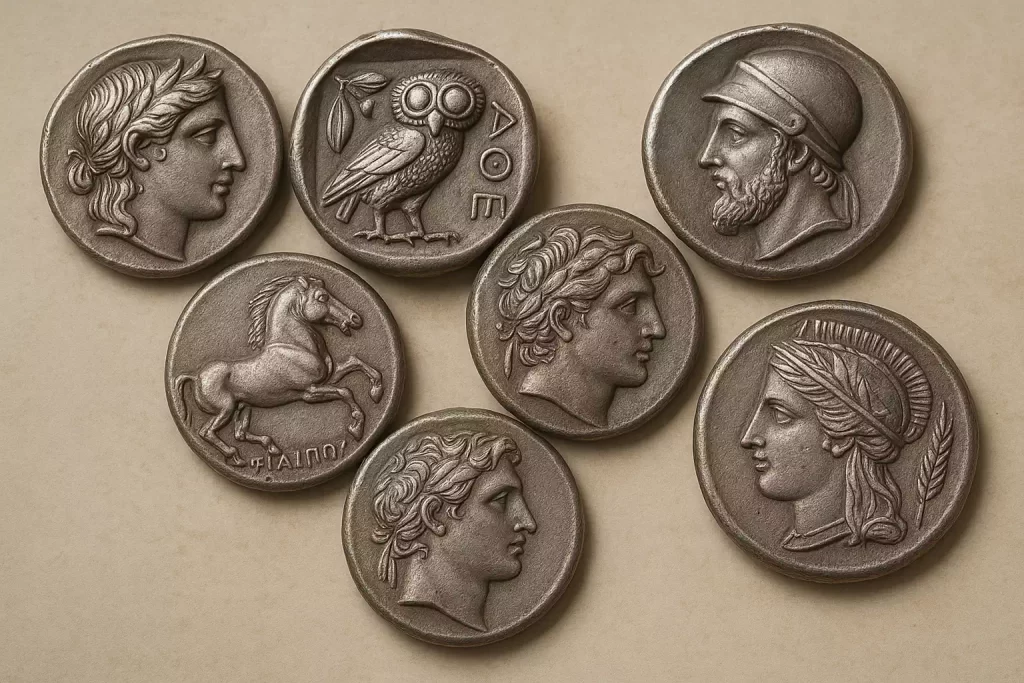
Inscriptions played a vital role on Greek coins, often giving the name or abbreviation of the issuing city-state, along with references to local deities or civic projects. For example, many Athenian coins bore “ΑΘΕ” for “Athens,” making them instantly recognizable. Inscriptions not only facilitated verification for commercial transactions, but also anchored the coins within the broader identity and pride of their issuing cities.
Iconography and symbolism in coin design
Greek coins are famous for their intricate iconography, which highlighted symbols beloved by each city-state, like Athena’s owl for Athens or Corinth’s Pegasus. These images were carefully chosen to communicate power, religious devotion, and victories, serving as everyday reminders of civic pride. Over time, coin designs evolved from simple motifs to beautifully detailed portraits of gods, civic symbols, and even notable individuals or mythological scenes.
Types and denominations of Greek coins
Overview of different coin types
Across ancient Greece, a wide array of coin types and denominations was produced, tailored to meet the varied economic needs of city-states. These ranged from tiny bronze obols for daily market use to large silver dekadrachms reserved for significant state payments or ceremonial distributions. Differences in size, metal content, and weight reflected local standards and trade connections, while certain coin types were more prominent in specific regions.
The Drachma: Greece’s most famous coin
The drachma stood out as the most iconic and widely recognized Greek denomination. Celebrated for its stable value and broad circulation, the drachma became a benchmark for monetary transactions across the Hellenic world. Its fractional units (like the obol) and multiples (such as the tetradrachm) allowed for flexibility, supporting every level of exchange from daily purchases to major state operations.
Rare and notable Greek coins
Some Greek coins have achieved legendary status among collectors and scholars for their rarity, beauty, or historical resonance. For instance, the Syracusan decadrachms and Athenian “owl” tetradrachms are prized for their artistry and detailed design. These exceptional coins often reflect periods of great prosperity, victory, or unique civic projects, offering vivid glimpses into the values and achievements of ancient Greece.
The significance of Greek Coinage in society
Coins as symbols of City-States
In ancient Greece, coins acted as portable ambassadors for their issuing city-states. Each design and inscription conveyed a powerful message of civic identity, local pride, and even political status within the Greek world. For instance, the use of Athena or Zeus on coinage was a constant reminder of a city’s patronage and religious traditions, fostering shared identity among citizens and allies alike.
Economic impact and trade facilitation
The introduction of coinage fundamentally transformed Greek commerce, enabling more sophisticated and distant trade networks. Standardized weights and recognizable symbols reduced transaction risks and built trust among merchants, both within Greece and abroad. This monetary stability supported the rise of great markets, bustling ports, and even the financing of ambitious civic projects or war efforts.
Coins in cultural and political identity
Beyond economic value, Greek coins served as reminders of important civic events, leaders, or victories. For example, commemorative coins could celebrate a great military triumph, a new public construction, or the crowning of a victorious athlete at the Olympic Games. This direct link between currency and cultural memory made coins vital tools of communication, reinforcing political messages and shaping collective identity throughout the ancient period.
Final thoughts on the legacy of Greek Coinage
Greek coinage remains one of antiquity’s most impressive legacies, offering insights into the daily lives, ambitions, and creativity of its people. Today, these ancient coins are invaluable not only to collectors and scholars, but also to anyone intrigued by how currency shapes economies and societies. Their influence endures in the development of modern money, reminding us that the coins we use each day carry stories that reach back millennia.
Frequently Asked Questions about Greek Coinage
What are Greek coins called?
Greek coins are generally named according to their denomination, such as the drachma, obol, or stater. The term “Greek coinage” encompasses the varied currencies minted by numerous ancient city-states, each with their unique standards and designs.
What is the most famous ancient Greek coin?
The most renowned ancient Greek coin is the Athenian silver tetradrachm, often called the “owl” due to its depiction of Athena’s sacred bird. These coins circulated widely and symbolized Athens’ economic and cultural power in the ancient Mediterranean.
What is another word for Greek coin?
Besides specific denominations like drachma or stater, the word “numisma” (from Greek νόμισμα) is also used to refer to a Greek coin. Numismatics, the study of coins, draws its name from this term.
How can I identify a Greek coin?
Identifying a Greek coin typically involves examining its inscriptions, iconography, and metal. Notable features like the owl for Athens or Pegasus for Corinth help trace the coin’s origin, while weight and design style indicate the issuing period and city.
Why did the Greeks mint coins?
The Greeks began minting coins to streamline trade and commerce, replacing barter with standardized money. Coins also served to express civic pride, commemorate victories, and project the power and identity of each city-state across the ancient world.

ClassicWorldCoins was created by a passionate collector with a deep interest in ancient coins and their stories. Through this blog, he shares his discoveries, insights, and favorite pieces to help others explore the fascinating world of numismatics.