
How to clean ancient coins without damaging them
Apr
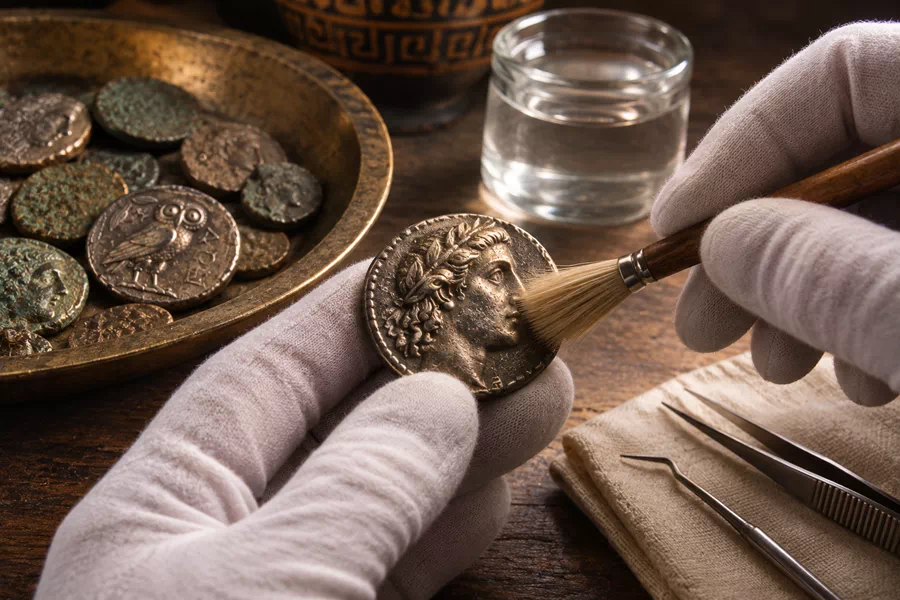
Ancient coins are irreplaceable objects whose surfaces carry centuries of history. Before reaching for any cleaning product, you need to understand what you are dealing with and what risks you face. This guide covers the safest methods for cleaning ancient coins, the mistakes that destroy numismatic value, and the cases where professional conservation is the only right answer. Whether you collect Roman, Greek, or Byzantine pieces, the same principle applies: patience and caution preserve value, impulse destroys it.
Understanding what patina is and why it matters
What patina is made of
Patina is a thin layer of oxidation that forms on metal surfaces over centuries of contact with soil, moisture, and minerals. On bronze or copper coins, it produces colors ranging from dark chocolate brown to sea green. On silver coins, it creates a darker, smoother toning. This layer is not dirt: it is the product of a slow chemical process that stabilizes the coin surface and becomes part of its archaeological identity.
How patina affects coin value
In numismatics, patina is considered evidence of authenticity and age. A well-preserved patina can significantly increase a coin’s value, while its removal almost always reduces it. Coin grading services such as the NGC (Numismatic Guaranty Corporation) regard inappropriate cleaning as one of the most damaging interventions a collector can make. A coin described as “cleaned” in a grading report fetches far less at auction than an untreated equivalent in the same condition.
The golden rule: consult an expert first
Before attempting any cleaning, photograph the coin from multiple angles under good light and consult a numismatist or a professional conservation service. An expert can determine whether treatment is necessary at all, and which approach is appropriate. The ICOMON (International Committee for Money and Banking Museums) recommends involving a trained conservator before intervening on any numismatically or historically significant piece.
Safe methods for cleaning ancient coins
The distilled water soak
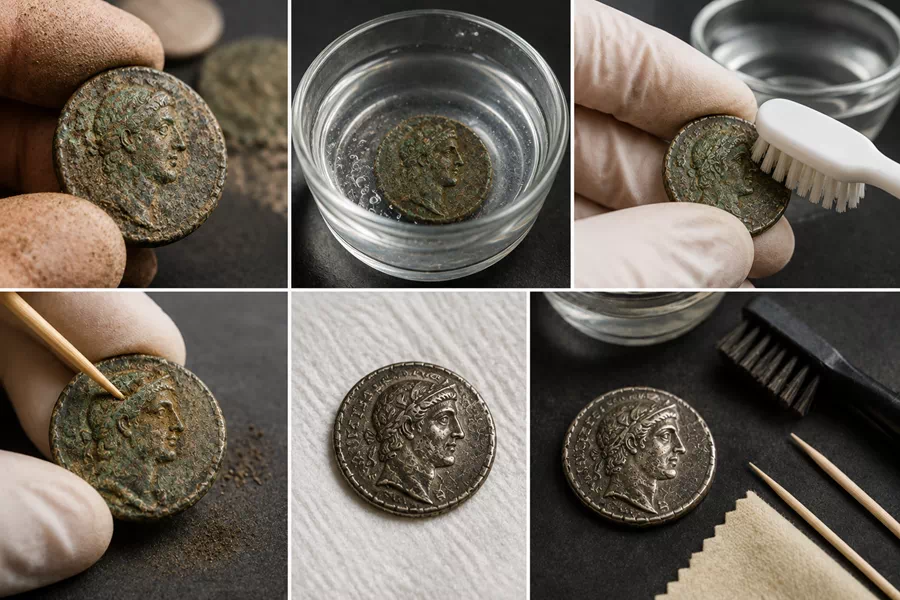
For lightly soiled coins, distilled water is the first and safest choice. Tap water contains chlorine, minerals, and fluoride that can react with metal surfaces, so it must be avoided. Place the coin in a shallow glass container with distilled water and leave it to soak for 24 to 48 hours, changing the water daily. Gently rinse and allow to air dry on a clean cloth. Do not rub.
Mechanical cleaning with a wooden toothpick
After soaking, stubborn dirt can be loosened with a wooden toothpick. Work slowly under magnification, applying minimal pressure. The goal is to remove surface deposits without touching the coin’s metal directly. Avoid metal tools entirely: even a soft brass brush will scratch a bronze or silver surface and leave permanent marks. For cleaning ancient Roman coins, this patient mechanical approach is what most experienced collectors rely on.
Olive oil treatment for encrusted bronze coins
Heavily encrusted ancient bronze coins are sometimes soaked in pure olive oil over several weeks. The oil penetrates beneath the crust and softens it without attacking the metal. Check the coin weekly and brush gently with a soft nylon brush. Note that olive oil darkens patina over time, which makes it unsuitable for every piece: neutral mineral oil is sometimes preferred as a gentler alternative.
What never to do when cleaning ancient coins
Household chemicals and their damage
Vinegar, bleach, hydrogen peroxide, and commercial coin cleaners are among the most common sources of irreversible damage. These substances dissolve patina in seconds and etch the metal surface beneath, leaving a dull, unnatural appearance that no subsequent treatment can reverse. A coin whose patina has been stripped by acid loses its archaeological character and a large part of its market value permanently.
Why electrolysis is for professionals only
Electrolysis is an effective technique for removing heavy mineral encrustations from ancient bronze coins, but it requires precise control of voltage, current, and exposure time. A small error strips the surface or causes pitting. This method should only be performed by experienced conservators who can stop the process at exactly the right moment. For amateur collectors, the risk far outweighs any potential benefit.
The abrasion trap
Any abrasive material, whether a metal brush, steel wool, baking soda, or polishing cloth, scratches the coin surface at the microscopic level, destroying the fine details that define its grade. Even products marketed for coin cleaning can be abrasive. The brightness they produce is not natural: it is bare metal exposed after the original surface has been removed, which any experienced numismatist will identify immediately.
How to preserve ancient coins after cleaning
Proper storage for your collection
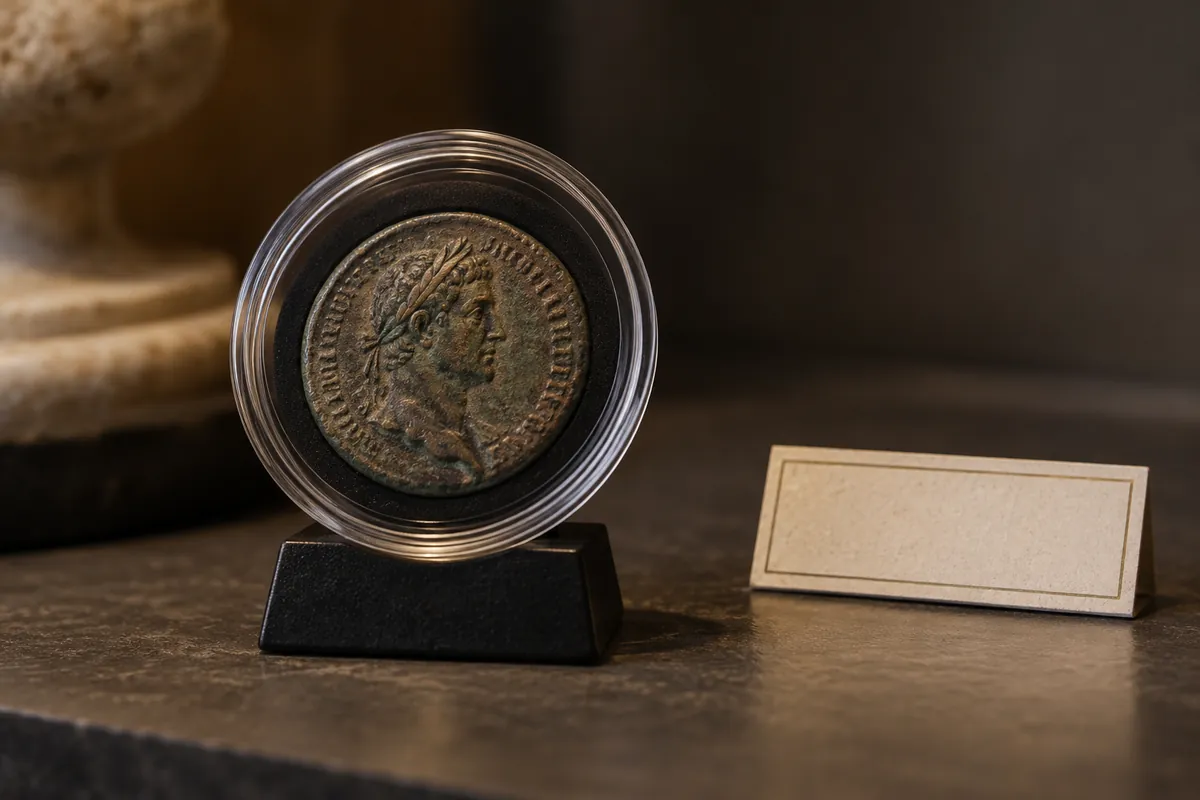
After any cleaning, store coins in archival-quality holders made from inert materials such as Mylar, polypropylene, or polyethylene. Never use PVC holders: PVC emits gases that react with metal and produce green deposits over time. Keep your collection away from light, heat, and fluctuating humidity, ideally in a stable environment with relative humidity below 50%.
Safe handling to prevent future damage
Always handle ancient coins with clean cotton gloves or hold them by the edges only. Fingerprints leave acid and salt deposits that begin corroding the surface within hours. Avoid breathing directly on a coin while examining it: moisture from breath can initiate corrosion on silver pieces in particular.
Questions about cleaning ancient coins
How to clean uncleaned ancient coins?
Soak the coin in distilled water for several days, changing the water daily. Once surface dirt has softened, use a wooden toothpick under magnification to remove deposits gently. Move to olive oil soaking only if mechanical cleaning proves insufficient. Never begin with chemicals on an uncleaned piece.
How do I clean old coins without damaging them?
Use a distilled water soak followed by gentle mechanical work with wooden tools. Avoid abrasives, household chemicals, and polishing cloths. When in doubt, leave the coin untouched and consult a professional numismatist or a conservation service affiliated with a recognized grading authority such as NGC or PCGS.
Does Coca-Cola clean old coins?
Coca-Cola is mildly acidic and can loosen surface dirt, but it destroys patina and etches the metal with prolonged exposure. Numismatic experts strongly advise against it for any coin of historical or collectible value. The short-term visual result comes at the cost of irreversible surface damage.
Is Dawn dish soap good for cleaning coins?
For ancient coins, dish soap should be avoided: surfactants can penetrate micro-cracks and leave residues that react with the metal over time. A very dilute soap solution may be acceptable for common modern coins but is not appropriate for ancient or historically significant pieces.
What is the best way to clean Roman coins?
Patient mechanical cleaning with wooden tools after a distilled water soak is the recommended approach for most Roman coins. Bronze pieces with heavy encrustations may benefit from an olive oil soak over several weeks. For pieces with significant archaeological or numismatic value, professional conservation is always the better choice.
Further reading
- https://www.ngccoin.com/ngc-conservation/
- https://icomon.mini.icom.museum/wp-content/uploads/sites/20/2018/12/Conservation_rules_for_coins_and_medals_.pdf
- https://www.ngccoin.com/news/article/105/

ClassicWorldCoins was created by a passionate collector with a deep interest in ancient coins and their stories. Through this blog, he shares his discoveries, insights, and favorite pieces to help others explore the fascinating world of numismatics.