
How did coins change the economics of the ancient world ?
May
Coins changed the ancient economy by making many payments easier to recognize, count and transfer. They helped merchants compare prices, gave governments a practical way to make payments and supported trade between communities. Their impact was considerable, but coins did not invent money or replace every earlier way of doing business.
To understand how coins changed the economics of the ancient world, we need to examine their origins and uses in Greece and Rome.
Before coins: how did people trade?
Ancient people traded long before coins appeared. They exchanged goods directly, but also used measured grain, weighed silver and other commodities to express value and settle obligations. Credit and written accounts mattered in some societies. Money is much older than minted coins.
Barter could be inconvenient if traders did not want each other’s goods. Weighed metal was more flexible but required checks. Coinage developed alongside older practices.
When and where did ancient coinage begin?
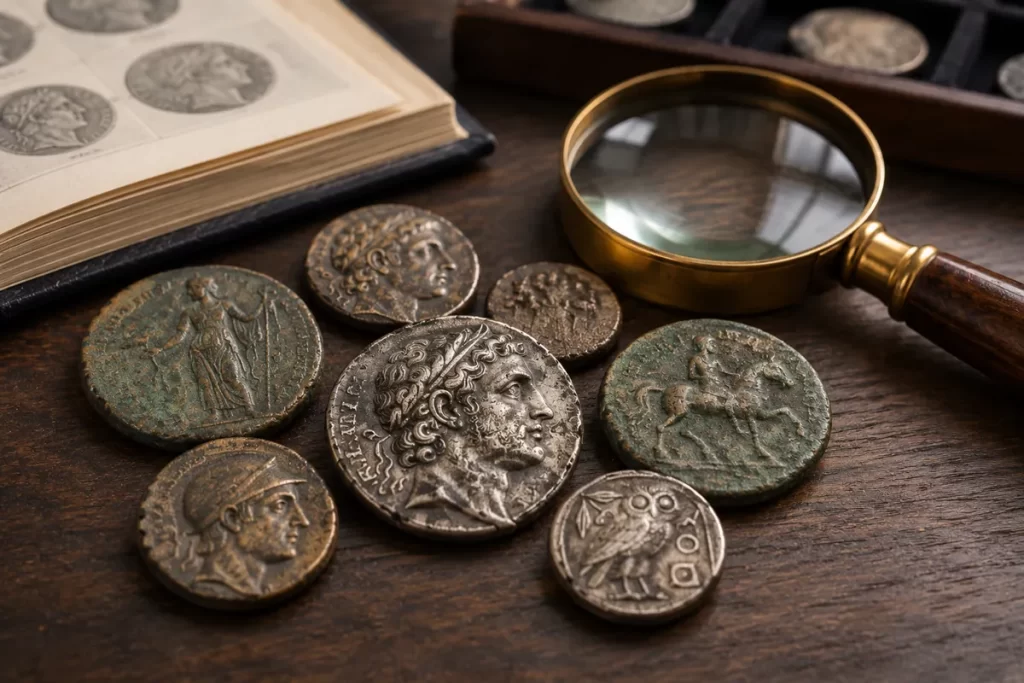
The earliest known struck coins appeared in western Anatolia, associated with Lydia and neighboring areas of present-day Turkey, around the late seventh century BCE. They were made from electrum, an alloy of gold and silver, and struck to recognized weight standards. Their marks helped identify an issue, although historians still debate exactly why the first coins were produced and who authorized every early type.
During the sixth century BCE, gold and silver coinage developed further in Lydia, while Greek communities increasingly issued their own silver coins. The idea spread through much of the Mediterranean over time. Other traditions also developed, including cast bronze coinage in ancient China.
For more context, see our guide to the oldest coins in the world.
How did the invention of coins make trade easier?
Recognizable weights and denominations
A coin struck to a familiar standard could be quicker to assess than an unmarked piece of metal. Buyers and sellers could count recognizable denominations rather than weigh every payment from scratch. Coins also made it easier to quote prices and combine smaller and larger payments where appropriate denominations were available.
That advantage depended on trust. A coin accepted in one city might need testing or exchange in another. Greek cities used different standards, so there was no single currency accepted at a fixed rate everywhere.
More practical market transactions
Portable coins in different denominations made some purchases and wages more convenient. Merchants could sell goods for coins and buy something else later.
This encouraged monetary transactions where coin supplies and local acceptance made them practical. It did not mean that all ancient markets suddenly became coin-based or that coins alone created long-distance trade.
Trade across cities and regions
Recognized coin types could circulate beyond the places where they were minted. Merchants, soldiers and other travelers carried coins across political borders. Common weight standards sometimes helped traders deal with different cities, although money changers and local valuation practices remained important.
How did coins affect the ancient Greek economy?
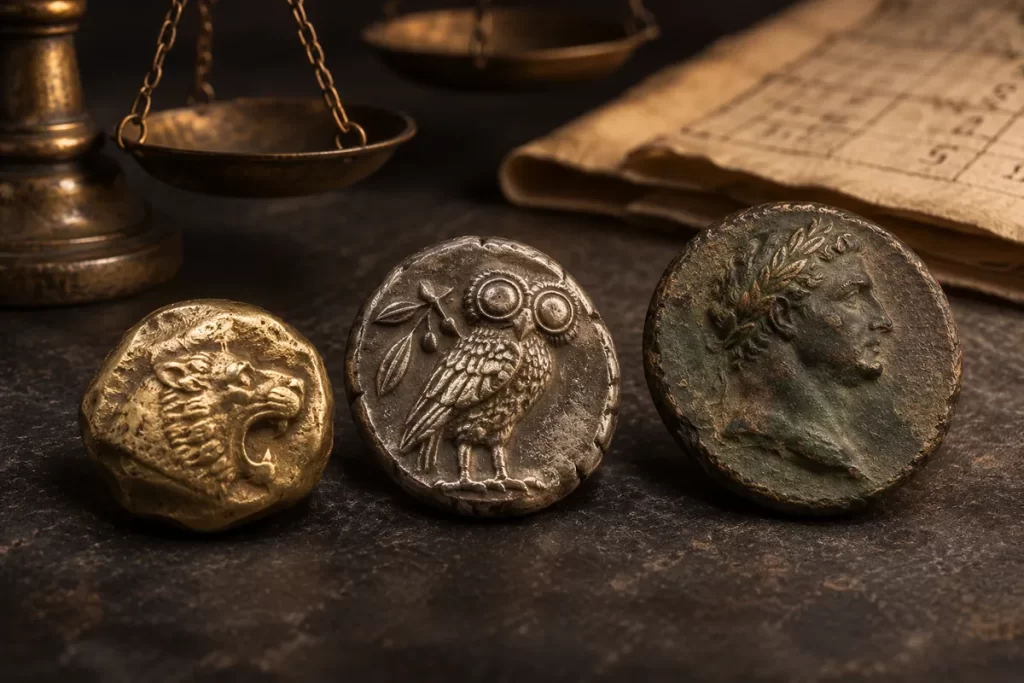
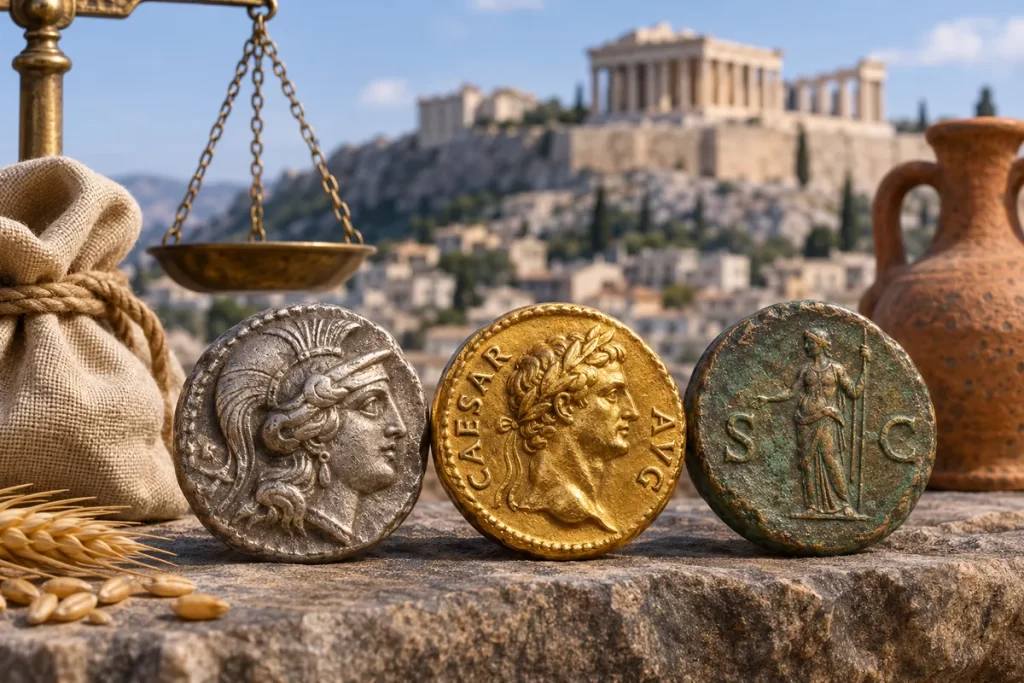
Greek city-states minted coins for different economic and political needs. One well-known example is the Athenian silver tetradrachm, bearing the head of Athena and an owl. Its reputation for reliable silver content contributed to its recognition well beyond Athens.
Greek coinage could support market exchange, public expenditure and payments to soldiers. Yet coinage was only one part of economic development: silver resources, maritime networks, laws, production and political relationships also mattered. It would therefore be misleading to claim that adopting coins automatically made a Greek city wealthy.
How did Roman coins support trade and the empire?
Paying soldiers and meeting state expenses
The Roman state issued coins on a large scale to support military and other payments. Soldiers and officials who received money could spend it in towns and provincial markets, helping coins circulate through the economy. State spending could therefore spread monetary exchange far beyond the places where coins were minted.
Taxes and other obligations could be assessed or paid in money, depending on the period and location. However, payments in kind also remained important, particularly for supplies and military provisioning.
Connecting markets without erasing local differences
Roman imperial coinage circulated widely, helping link distant economic regions. Silver, gold and base-metal coins served different purposes, while local and provincial issues continued in parts of the empire. Roman rule did not eliminate local currencies or make exchange rates irrelevant.
Coins also carried the emperor’s portrait, titles and messages. This made them instruments of political authority as well as objects of exchange. Our collection of Roman provincial coins illustrates the variety of issues produced under Roman rule.
Coinage, taxation and political control
One important economic effect of coinage was that it gave states a flexible tool for making payments and collecting some revenues. Coin production could help rulers finance armies, pay workers and carry out public projects. Minting also allowed authorities to promote recognizable images and claims to legitimacy.
But issuing coins did not guarantee prosperity or stable prices. Their usefulness depended on metal supplies, public confidence, acceptance and the policies of issuing authorities. Changes in coin weights or precious-metal content could complicate payments and undermine trust.
What did coins not change immediately?
Coinage did not eliminate barter, credit, weighed metal or payments in goods. Its use varied considerably between rural and urban areas, social groups and regions. Even within major empires, people could use several monetary practices at the same time.
Likewise, the appearance of coins does not prove that a society suddenly developed markets, specialization or international commerce. Those activities already existed in many places. Coinage made certain kinds of exchange and administration easier within economic systems that were already changing.
Frequently asked questions
Why were coins important in ancient history?
Coins provided a recognizable form of payment and a way for authorities to issue money. They also preserve evidence of rulers, political messages, trade connections and the economies in which they circulated.
How did the development of coined money change trade?
Recognized weights and denominations could reduce the need to assess metal in every transaction. Coins also made it more convenient to receive payment for one good and spend it later on another, although conversion between local currencies could still be necessary.
Did coins replace barter in the ancient world?
No. Barter, credit, weighed metal and payments in kind continued alongside coins. The balance between these methods depended on local customs, available coinage and the type of transaction.
Why did ancient states mint coins?
Reasons varied. Coinage helped some states pay soldiers and officials, undertake public expenditure and provide money for exchange. Coin designs also expressed political authority. Historians continue to debate the precise motivations behind the earliest issues.
The lasting economic impact of ancient coins
Coins made many ancient transactions easier to organize and helped states distribute payments across large territories. Their spread contributed to trade, public finance and the circulation of political messages. The crucial distinction is that coins strengthened existing economic networks rather than creating commerce from nothing. Their history shows how technology, trust and government authority can shape the way money is used.


ClassicWorldCoins was created by a passionate collector with a deep interest in ancient coins and their stories. Through this blog, he shares his discoveries, insights, and favorite pieces to help others explore the fascinating world of numismatics.